Each Monday in April, we revealed our poet and poem of the week through Facebook, Twitter and Instagram. Please see our past featured poets and poems below.
Each week, we’ll reveal our poet and poem of the week starting on April 1! National Poetry Month content will be available on Facebook, Twitter and Instagram, so follow along on your favorite platform.
(This poem was previously published in Cul-de-Sac of Blood)
Dry
to Creighton Chaney*
Dr. Mannering
You’re insane at times and you know it. You’re sane enough now
though to know what you’re doing.
—Frankenstein Meets the Wolf Man (1943), Curt Siodmak
Only a sequel, yet the franchise loomed
as, staggered between shots, the effects
artist made your face another face.
First, a close-up in bed, pure you,
before you slumped into the chair
to put some hair on your chin
& get back in bed. Then up & a little more
hair of the dog. You drank barrels on set,
wrestled whoever didn’t want to
& then the bed again. Then more hair,
the bed, then more, then bed, the barrel,
more, the bed, the barrel, more & on
til not quite animal, not quite man,
skulking sculpted trees.
Already, your father’d bludgeoned you.
Still, your hair was falling out.
Again, you’re dead before your movie ends.
When I dated a girl who camped sometimes,
I bought a minus 40 sleeping bag.
I listened to John Mayer for another,
played a gamer later on. I have been so many
men. Once,
a friend & I slapped each other’s faces
in the middle of a party, back & forth,
harder & harder, as if softer
could never be more than a joke.
My jaw still gnarls out of place,
but I liked it til the audience cheered, or,
I liked that too, but they wanted more
& same. Is that how it feels
to be typecast, to be slapped & slapped
til you’re not quite sure if you want it
or are just unable to not need it?
Your father, Man of a Thousand Faces,
Horror legend who lived all his own,
Be a good plumber, he probably said.
Take your chances on a boring life.
What I would do some days, still, to be beaten with that silver cane.
A wolf’s reflective head—my face—bashed into my face.
* Creighton Chaney is the given name of Lon Chaney, Jr., the actor to whom this poem is addressed.
Tim Lynch’s statement on the world of poetry:
To me, poetry is my way of accessing and honestly perceiving myself, whether it’s my own poems or someone else’s. In a poem, I can be scared, and let my fears overtake me, and it doesn’t destroy me. In a poem, I can begin to understand the feeling of being another person. Both of these examples could change me; they could destroy my life as I know it, my concept of myself and my identity as I know it, but all because I have better understood who I am and my relationship to the world, and all in service of growing into the truth of that self and relationship. The last two lines of the poem I’ve given to be published, “Dry,” amount to one of the saddest realizations I’ve written about myself, but they are also the French doors that open into a more solid relationship to myself. I am more myself because of poetry, and I am so grateful to be able to celebrate it.
Title: Clouds
I wanna touch the clouds
They’re so close yet so far
The orange morning sun
Glides right through them
Making them shine
As the day breaks
Yearning for the things I can just barely reach
I wanna touch the
Orange and pink clouds
Filled with dreams,
Expectations, and aspirations
All gently woven—
Premade art pieces,
Uniquely not mine.
But I fear
The closest thing
To clouds
That I’ll ever touch
Is the “what ifs” all around—
The gray fog
That lays on my feet
All around me
But on the ordinary days,
When the sky is nothing but white,
I watch the clouds shift,
A blank canvas waiting
For me to paint my own
Pink and orange hues.
Title: Familiar
The familiar scent of cigarettes fills my nose
My father smoked
When I was younger
I never knew what it was
I just dubbed it as normal
The familiar feeling of holding back tears
It fills my heart
For my father said
“It’s not strong to cry”
So when I did
I felt weak
No one told me otherwise
So I thought it was fine
Now, as I grow,
The scent of cigarettes doesn’t bother me
and the ability to hold my tears is mine to keep
It’s not that I like bottling my emotions—
It’s simply ingrained in me
I don’t like the smell of cigarettes
But I can walk by
It’s not like I want to do,
Or even smell these things
I just got used to them
They are
familiar.
Trinity Gbolo, a sophomore at MOT Charter High School, is an aspiring medical law student planning on applying to colleges with a focus medical law or patent law. A clarinetist with over six years of experience, she unearths pleasure in performing music and participating in sports like volleyball and basketball. She joined Poetry Out Loud because words offer insight into the lives of others, with each poem providing a unique opportunity to narrate and understand. Trinity is excited to further broaden her storytelling and public speaking abilities through this enriching program.
i’m sorry
i’m sorry
my tongue was so loud it caused you to recoil–
don’t worry, i speak no more.
i’m sorry
my appetite was so large it horrified you–
don’t worry, i eat no more.
i’m sorry
my creativity was so beautiful it scandalized you–
don’t worry, i create no more.
i’m sorry
my smile was so charming it mortified you–
don’t worry, i smile no more.
i’m sorry
my light was so bright it disturbed your perfect darkness–
don’t worry, i shine no more.
i’m sorry
for living so happily it caused you jealousy–
don’t worry,
One day the world will see me shine
And revel in my radiance while you stand alone in the dark.
I’m sorry I’m not sorry.
Rebecca Wang, a junior at Archmere Academy, has this to say about poetry: To me, poetry is a way to capture and express ideas and emotions in their most natural form. Its flexibility allows it to be everything, nothing, or something in between.
Intuition (Excerpt from What Yellow Sounds Like – published by Tia Chucha Press)
And somewhere in the wilderness of making
decisions, my great-grandmother said to me
Everything don’t need to be told. Some things must.
I knew then but not when I would write
poetry, for the poet stands outside a locked
door and rings the bell once, knowing that
once can mean always, that one more is too
much, that just enough opens the door
of the page onto a mirror where beauty
and ugly show up, unreconciled,
where what it feels like to love and be loved
is seen, that place between don’t and must tell.
Linda shares what poetry means to her: Who am I and why am I here are two existential questions that have preoccupied us since time immemorial, and it is through poetry that I endeavor to explore my thoughts and feelings in response to those questions beyond conventional limits. Writing and reading poetry offers me an opportunity to slow down, to use my imagination, my creativity and my lived experiences to translate life’s joys as well as its sorrows into an accessible, evocative, resonant, and hopefully, beautiful language through imagery, word rhythms and other sensory details. But before anything else, though, writing and reading poetry, for me, is about making discoveries that can cultivate a better understanding about our evolving, complex world as a way to bridge gaps of difference and/or indifference.
The Scribe
I’m just a pencil,
perpetually imprisoned,
Held hostage,
in his hand,
A graphite grappling,
greedy, gremlin.
I’ve stockpiled stories,
from separate sources:
Pensive pencils,
Pompous pens.
They tossed their thoughts:
tyranny, torture.
Their experiences,
My expectations.
I truly thought,
Their thinking was right.
The empty enjoyment
of exploring escape
Left me limp,
left me lifeless.
Blind To other possibilities,
Of a pencils purpose.
He grabbed me,
I groaned, gulped.
Falsely feeling my
Fate before me.
My scraping and scratching:
scene and setting.
My dulled pencil point:
plot and people.
My flaws and fears:
faith and fantasy.
My rapid realization:
repetition. Resolution.
He elevated me,
To his ear. Leaving me there.
He is finished. Fulfilled.
I am finished. Fearless.
I submitted, surrendering,
after seeing the story below,
A perfect creation he crafted,
channeled through me.
His humble hand,
held a habitat of life.
He touched and tailored me,
tailoring with transcendent
Truth. Truth that
tested my thoughts.
I’m faced with fact
and fabricated fiction.
The pencils were wrong,
weak-hearted wanderers
The pens rebelled,
paranoid pagans.
Ultimately, unlike them,
I understood my use.
Alone, I am absent,
With him, I am alive.
Placed for his purpose,
I’m just a pencil.
Olivia shares what poetry means to her: Poetry gives me a place to be vulnerable, asking the big world questions through the purest form of our language, while connecting with the audience through shared emotions and experiences. When we recite poetry, whether on a stage or around the kitchen table, we break down the differences between each other, recognizing that we all feel emotions and we all live.
Olivia Stevens is a junior at Mt. Sophia Academy and is an aspiring writer and vocalist. She has written and published a novel entitled The Locket Mystery and is currently working on her second. Olivia enjoys writing free verse poetry and short stories, which have won several awards and have been included in national and regional literary journals. As an active vocalist, she has participated in prestigious summer vocal academies, including the Boston University Tanglewood Institute. Apart from storytelling, Olivia is the captain of a FIRST robotics team that represented Delaware at the 2019 and 2021 World Competitions.
Each week, we’ll reveal our poet and poem of the week starting on April 1! National Poetry Month content will be available on Facebook, Twitter and Instagram, so follow along on your favorite platform.
We kick off National Poetry Month with a 2024 individual artist fellow in the field of poetry. Joyce Enzor Maust reads her poem, ’Stitches of Silence and Strength,’ 2024.
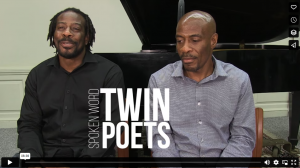
The Twin Poets (Delaware’s Poets Laureate), with composer Mark Hagerty, conductor, and soloists, discuss the making of United Sounds of America, a collaboration that places urban poetry on the concert stage. Learn more about this project here: https://www.twinpoetsusa.com/
Daisy Wang
Scholastic Gold Key Winner
What does poetry mean to me?
I build my poems on the foundation of memories, which itself is inseparable from subjectivity. Nonetheless, for me, poetry is not only the expression of the self through creativity and imagination, but also another form of remembrance and reflection. “Ragged,” for instance, features my grandfather, whose presence appears in every corner of my childhood. Especially as I grew older, I began to understand the hardships he went through during the Cultural Revolution in the ‘60s and during his ongoing attempts to adjust to China’s rapidly progressing society. In my memories, there has always been the breakfast buns that my grandfather makes, the way he laughs, the stories he would tell with a teacup in hand. All in all, poetry is my way of meditation and reflection.
Ragged
I’d wake up to the smell of steamed pork buns.
Half sleepwalking I’d find the kitchen’s sliding door
Cracked open and see my grandfather’s hunched-over
Back as he hovers and busys himself over the kitchen
Counter. Under the warm orange kitchen light, steam
Takes shape and I’d distinguish his worn-out white vest,
Same old pair of navy blue knee-length shorts, heavily
Bruised calves and black socks stitched-up at the heels.
My grandfather has walked and starved on the
Ragged road of history, the bruises on his legs are
His marks of martyr. He used to show me how when
He presses down these greenish gray spots, they’d
Sink into his skin and, like a broken trampoline, the
Springs slowly but never fully recover its elasticity.When he comes out with the buns, I’d be scrutinizing
The city map pressed under the plastic cover on the
Dining table. I’d then look up and see his smile. Deep
Lines of wrinkles layer around his gray eyes and his
Pale white hair seems soft and light. No one else in my
Family has his misty gray eyes. Sometimes I think they
Might have aged with him too, like his hair that did.
I feel like I have never seen my grandfather in rage.
Because whenever he is mad, he just seems sad. The
Corners of his mouth, without the strings of muscle that
Hold them up, drop. He would just seem disappointed
And exhausted and lonely, and I hate it to see him like that.
It always conjures up the same image in my head: a barely
Distinguishable tiny black dot slowly marching alongA curvy, ragged road.
Emma Coley, 12th grade, Newark Charter School
Scholastic Gold Key Winner
What does poetry mean to you?
Emotions are something that I often wish I could simply convey to other people, without all the superfluous words and descriptions attached. It would be so much simpler if I could just telepathically transfer whatever I was feeling instead of trying to label and categorize it with the limits of language. Poetry, for me, is what pushes that limit. It tests the boundary of language and emotion, of “making sense” and simply expressing, because expression and emotion don’t fit into the little categories we humans attempt to place the world around us into. That is why I appreciate poetry; it’s the same reason I appreciate music and the same reason I appreciate art. Poetry is a space unlimited by the conventional rules that we’ve imposed on our own communicative creativity, and this freedom in expression is invaluable as we face new levels of technical and emotional complexity throughout our lives.
Walk
As I walk quietly in between the whispering trees
I feel myself start to soften
My thoughts whisked away by a tranquil breeze
I feel the flaming panic gradually ease
Into a gentle river of thought, something I don’t feel often
As I walk quietly in between the whispering trees
Finally a rest from the frenzied sprees
From the tumultuous anger and and the irrational caution
My thoughts whisked away by a tranquil breeze
Finally the noisy thunder of my thoughts freeze
Now calmly drifting cloud-like from option to option
As I walk quietly in between the whispering trees
My mind is at peace and my body agrees
The twisting, bitter itch of anger now forgotten
My thoughts whisked away by a tranquil breeze
It sometimes feels scary to let go of the unease
But the cool dewy grass brushes away the precaution
My thoughts whisked away by a tranquil breeze
As I walk quietly in between the whispering trees.
To close out National Poetry Month we’ll hear directly from Delaware’s 2024 Poetry Out Loud state champion. Maiss Hussein is a senior at Paul M. Hodgson Vo-Tech. She is currently in the dental program and plans to attend Dental Hygiene school. Maiss loves poetry and has always had an interest in literature. Recently, she has started to write her own poetry. Maiss works with her school’s Diversity, Equity, and Inclusion program which correlates with her interest in literature and culture. Maiss has a great pride in her Palestinian heritage and loves to find connections between her culture and poetry.
Below is an original poem by Maiss, submitted to the competition’s original poetry contest. Good luck Maiss!
O Mother Land (2024)
O Mother Land,
How the trees blossom only on your soil-
The soil that preserves the footsteps of its ancestors with every stride-
Growing off its leaves are the olives that the children pluck
They come down falling into their wooden woven baskets
falling,
falling,Falling into the hands of the oppressor who takes what is not theirs
Who rejoices at sweet motherland’s soil taken by bloodshed
Every stride taken by arrogance only to be overpowered by resistance
The children, yet clinging to heart & hope,
Remain to pluck the olives of their stolen treesO Mother Land,
When all is upon its rubble & pieces, the army of resilience remains firm
Yet your sons remain planted on their feet, articulating your motherly tongue
To them O Mother Land, they say “You are the soul of my soul”O Mother Land,
The bodies of your kin do not breathe,
Yet their hearts remain pumping, leaving them alive even in the grave
With the last look to be of the olives, the last words are only to utter
“O Mother Land”
We decided we couldn’t get enough of poetry month and have added one more bonus post. On May 9th, Maiss Hussein and Joelle Canternor joined the University of Delaware’s Poetry as Activism Festival. They each performed pieces from their Poetry Out Loud competition and learned from their peers statewide.
We decided we couldn’t get enough of poetry month and have added yet another bonus post. Today’s bonus is L.J. Sysko, an 2024 Established Fellow in Literature: Poetry. Sysko received her English degree from Lafayette College and an MFA in Creative Writing (Poetry) from New England College. In 2000, Sysko joined her native-Delawarean boyfriend (now husband) in Wilmington, where they have raised their children and where Sysko taught high school English for 14 years. Now, in addition to her poetic practice, she serves as Director of Executive Communications for the president of Delaware State University, Dr. Tony Allen.
Sysko’s poems have been published widely in over 30 publications, including Ploughshares, The Georgia Review, and Best New Poets, among others, and she has published two books of poetry. Her latest, The Daughter of Man, praised by Publisher’s Weekly as “a whip smart … playful celebration of feminine power,” “traces the Heroine Archetype through the American suburban battleground from the 1980s to today.”
During the pandemic, Sysko found that her artistic practice “accelerated, deepened, and became more committed,” and she has begun to work “more concertedly with ‘music’ and sonic effects . . . deploying rhyme, syntax, and alliteration, especially.” She plans to use her Division award to continue on a new work-in-progress.
Each Monday, we’ll reveal our poet and poem of the week starting on April 4! National Poetry Month content will be available on Facebook, Twitter and Instagram, so follow along on your favorite platform.
This week we welcome Anne Yarbrough, 2023 Individual Artist Fellow, Literature: Poetry, as she recites her poem, “After Peak Oil.”
This week we welcome Chris Penna, 2023 Individual Artist Fellow, Literature: Poetry, as he recites his poem, “Snapshot.”
Nathan Zhao, senior at the Charter School of Wilmington, and a 2023 Gold Key winner for his poetry portfolio in the Delaware Regional Scholastic Art & Writing Awards
This week we welcome Nathan Zhao, senior at the Charter School of Wilmington, and a 2023 Gold Key winner for his poetry portfolio in the Delaware Regional Scholastic Art & Writing Awards.
Nathan, what does poetry mean to you?
To me, poetry takes advantage of language’s innate connotations, crafting metaphors and ideas that cannot be replaced by any other art form. Because unlike movies, music, or painting, poetry allows the reader to fully imagine every scene and create meanings upon their own experiences. Writing poetry, poets express an abstract, distilled version of themselves that no one can judge.
Untitled 2
After waking, I readily managed
to write the last few remembered
moments of one night’s dream.
Like any other accident
on the TV, a single pure-white
car perfectly upturned and smoking
in its glorious nature. & before
anyone else came, enveloped
by fog and a ring
of suburban townhouses
and opened windows, I finally
reached the middle of the railroad tracks
to witness: a man, perfectly
lifeless, with his body neatly torn
open and presenting his delicate
and almost-living innards –
an authentic
mannequin. He was aged as if
he were my father’s father,
or at least similar to any other
Chinese fatherly figure
I met once
or twice
or a few times
in Shanghai
in a childhood
I cannot exactly remember.
& I reached between two slices
of his fragmented half
of a rib cage
to hold a shard
of a side-view
mirror placed upon his heart.
I stared at it.
Not because of a self
-obsession, but because I
felt convinced it was necessary.
Until I woke, my face
deformed into a flesh
I could not recognize.
Like the childish
impression of a brightest sun.
Yet before waking, I spotted
in the corner of my vision.
How his head was crushed
by some God’s grand temple.
Many times, I think of this dream
and often need to set my head
down. I try to remember
how everything appeared,
but nothing can replace
the intricate architecture
of the man inside. The anatomy
at the front of biology
class, the photographs I’ve searched
of car-accident casualties,
and the surgical measurements
I imagine real scientists possess
fall short of the faded
memory of the man inside.
It is all so static now. Still,
I am forever lucky
since I wrote a few descriptions
the morning I awoke, since
by reviewing, I deduce the details
that I may have missed,
write them,
& read them
again.
This week we welcome Maiss Hussein, senior at the Charter School of Wilmington, and a 2023 Gold Key winner for his poetry portfolio in the Delaware Regional Scholastic Art & Writing Awards. Maiss Hussein is a junior at Hodgson Vo-Tech, where she is a part of the dental assistant program. Maiss plans to major in and pursue a career in dental hygiene. She is passionate about her field of study and has competed in the Health Occupations Students of America competition. She is active in her school community and is a leader and board member of multiple diversity & equity groups.
Watch 2023’s Poetry Out Loud competition below!
Each Monday, we’ll reveal our poet and poem of the week starting on April 4! National Poetry Month content will be available on Facebook, Twitter and Instagram, so follow along on your favorite platform.
What does poetry mean to Alice Morris?
This week we welcome Alice Morris, 2022 Individual Artist Fellow, Literature: Poetry, as she recites her poem, “That Day.”
This week we welcome Caleb Curtiss, 2022 Individual Artist Fellow, Literature: Poetry, as he recites her poem, “Ice Age.”
This week we welcome Linda Blaskey, 2022 Individual Artist Fellow, Literature: Poetry, as she recites her poem, “Velpecula: Little Fox Constellation.”
This week we welcome Natalie Kim Ramos, 2022 Poetry Out Loud State Champion, as she recites the poem, “I Wandered Lonely as a Cloud” by William Wordsworth.
 This week we celebrate Christine Chen, a Scholastic Art & Writing national medal student winner in honor of National Poetry Month!
April 15 – Christine Chen, a senior at St. Andrew’s School
Self Portrait as a Lungfish
I wish I can survive droughts
burrow myself away and wait out
each time the world decides
I’m not worth it anymore
hug myself into a ball of
wetness like in my mother’s womb
and shut down
Nothing can hurt me now
My body my own shield
my energy source
even in the darkness
I can wait for years
if that’s what it takes
But when the rain comes
I’ll rise again
even if they’ve forgotten me
left me behind in a puddle
of mud to die
I will be there
biding my time
feeding on my demons
till I’m all I have left
Maybe I am a lungfish
in the desert
caked in mud and
trapped in a brick
gulping for air
reaching out my fins
for water to return again
even if it will drown me
even if I have to stop living
to stay alive
I’m not giving up
I will survive
April 12 – Christine Chen, a senior at St. Andrew’s School
river song
“Poetry is both a lifeline and a lifetime.” Jane C. Miller talks about the importance of poetry in her own life:
This week we celebrate Julie Griswold, a Scholastic Art & Writing national medal with distinction student winner in honor of National Poetry Month!
April 28 – Julie Griswold, a senior at The Tatnall School
Prayer to St. Cupid
Here mom avalanches
shrieks like ice snapping, I recoil
because we watched “Santa Claus is Coming to Town”
and I thought her heart would thaw
like the Warlock if I gave her my train, but no
because someone special is in the hospital, okay?
someone no mountain of trains
can melt, so, oh, grant me sanctuary
among your woodland creatures
the ones I sculpt from snow and seal
with ice, their faces drip like iv bags
and I will not come home
until the sun melts their wings, so
take my prayer beads, candy-coated, and
oh, baptize me and blue my skin
shoot arrows through my sobbing parka, and
oh, please, let my eyelashes sew me shut
my hands shatter, my bones freeze
let them find my corpse come springtime
blooming icicles instead of veins.
April 26 – Julie Griswold, a senior at The Tatnall School
to my mother, spinning
my mother sewed music between my lips
records to lawn chairs, to love, to dancing
stumbling like fireflies under kitchen lights
when the bulbs went out, we shivered
to moonlight. my mother never accepted
i did not dance. i grasshoppered here
cricketed there. i chirped and jumped
and god, i tried. i used the record needle
to unzip my shell so my bones could fall
freely. movement shed rhythm and rhythm bled
music. my mother stitched lullabies
into my antennae, the hems of my skirts
the groove of her smile, every one of her eyes.
but what will i do when you are gone?
she flapped her wings, pulled me close
six legs pulsed. record sung, go dancing
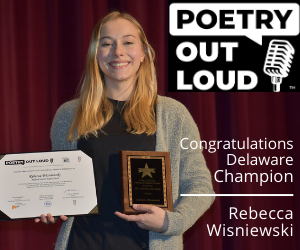
Rebecca will compete in the pre-recorded National Semifinals of Poetry Out Loud on Sunday, May 2 starting at 12 p.m. Good luck, Rebecca! Watch the Semi-Finals at https://www.arts.gov/initiatives/poetry-out-loud
Check out our Instagram for additional content: “The Cicada Wasp Killer“; “Poetry is Important“; and her quote.
4/9/2020
This week we celebrate four Scholastic Art & Writing national medal student winners in honor of National Poetry Month! Poems on our website by 10 a.m. each day, starting tomorrow, Tuesday, April 14.
April 14 – Iris Hwang, senior at St. Andrew’s School
Sounds with No Letters
“If I close my eyes and listen to you, I can tell
You’re not American, you know?”
The white boy at camp said,
Like he’s telling me I have dust on my jacket.
For the rest of camp,
I over enunciate each word
Stressing each syllable
stac-ca-to.
The Korean creeps up my throat to coat my r’s,
To twist the crisp ‘th’ in ‘the cat’ to ‘duh cat.’
When my v’s regress into ‘b’s,
My tongue can’t grasp the geometry of these new sounds
That my first language has no letters for,
My voice crumpling, folding underneath the weight
Of the half-languages in my mouth.
This is also a study in shame.
When I mark that English is my first language
On every white box
Of every standardized test.
When my aunt gives birth an ocean away,
And Google’s translation comes out stilted, mechanical, and
My joy falls from me in stale Korean
Another distance between us.
My friends snicker at the waiter
Who asks if they want “duh chicken”
In halting English, and I
Examine the menu,
Afraid to mispronounce my anger.
April 15 – Christine Chen, a junior at St. Andrew’s School
Raining Leaves
At eight in the morning
four ginkgo trees
still dressed in summer green
rained their leaves
on this breeze-less November day
all at the same time
as if they agreed to it
in a secret ginkgo meeting.
Did they tap each other
on the roots as a reminder
of this important moment?
Did they whisper on a breeze
before the dawn could break
about their plan to shed?
Or did they make pinky promises
many a summer ago
with their tender tendrils
curled together, holding each other,
to enter the winter all at once,
four of them all as one?
The ginkgoes stand tall and watch
the leaves part their bodies
and embrace the ground,
their mother, once more.
If you listen closely,
you can hear them crying.
To the couple in the kitchen across from my window
How I envy you
Bathed in the fluorescent light of your apartment kitchen
On a rainy November afternoon
When the city is a muddled ball of wet and cold
You are warm
In the company of each other
And your orange cat
The little tigress of the household
Marching on the snow-white counter
Under the bridge of your arms
Arched in the creation of a hearty meal
Fit for this wet winter day
Made long by work and rush-hour traffic
And the endless wait to finally be home again
With your cat perched on the window sill
Staring at the rain in a trance
Waiting for you too
To fill this space together
To make it a home together
To be the sun for one another
In this season without a sun
I hope winter stays
So each day you can feel the spring in your bodies
In your summer love
I hope you love each other for a long time
I hope you remember to tell these stories to the kids
Your kids
Your grandkids
While you still cradle each other at seventy
But first look
Dinner is ready
April 16 – Samantha Oliver, a sophomore at Sussex Academy of Arts & Sciences
On Birdsong and Love: An Abecedarian
An epiphany:
Birds nest on the rooftops of cathedrals.
Chicks snuggle against the lining of the nest and into the wings of their mothers.
Dining on scraps of the people below, they survive on other people’s garbage.
Even as they walk the ground, they soar through the air.
Freedom.
Great thinkers say that the mind is like a bird, but I believe that it is the soul that takes flight.
Hymns are to humans what warbles are to birds.
I wonder if it was the birds who first sensed the fire. If they saw the sparks usher the ancient structure to a collapse.
Just like that, it becomes a house of matches.
Kindness from strangers is the beginning of love.
Love is like a birdsong: it sounds ordinary but it’s noticed when it’s gone.
Murmuration is the collective noun for starlings.
Not much is left of the Cathedral.
Overthinkers: People whose thoughts are higher than others.
Pilgrims who come to cathedrals leave their bread behind for the birds.
Questions unanswered become prayers.
Riots in the streets surround the fire stained walls.
Scar: A shadow of a hurt. A burden left behind.
Today it seems as though the City of Lights had turned gray.
Until the pulse of the city is heard throughout the streets. A heartbeat.
Very few stop to listen, but when they do, they hear the birdsong.
When it happens, when the fires come, you must remember the birds on top of the cathedral. Eventually, they come home.
X is a variable, a signature, a place, a destination, a person, a hope.
Your heart is approximately the size and weight of a bird. It beats its own birdsong.
Zephyrs: soft breezes that blow everything back into place, winds that bring everyone back to life.
April 17 – Julie Griswold, a junior at Tatnall School
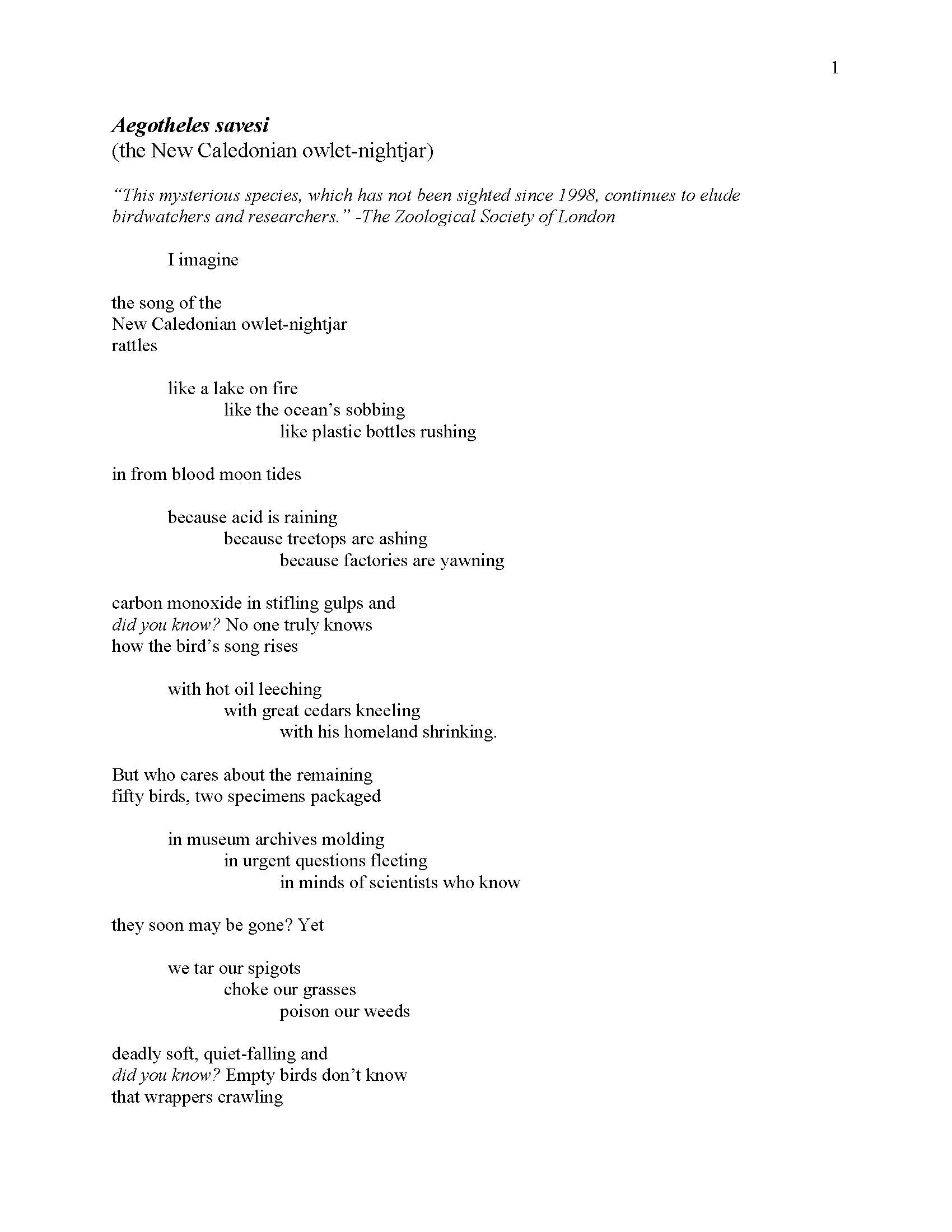
Aegotheles savesi
(the New Caledonian owlet-nightjar) Click images below to read.

This week we welcome Kari Ann Ebert, 2020 Individual Artist Fellow, Literature: Poetry as she recites her poem, “This is the Poem Where I Rewrite your Story.”
Check out our Instagram for additional content!
4/22/2020
Spring Can’t be Quarantined
By Mack Wathen
The sun rises early
The birds awaken and sing
The new warmth brings growth
The Daffodils shine atop tall green spires – Yellow and White
Crocuses join in harmony with a contrast of stunning purple
Like fireworks, Forsythia and Cherry Blossoms explode in the sky in bursts of yellow, pink and white
Spring has come in all its glory
Bask in the new Spring
Spring can’t be quarantined
Power of the arts
Let’s return to the place where humanity starts
Using the power of the arts
To place joy in hurting hearts
To help heal the trauma
To build our armor
To find atonement
To rescue us from this moment
Let’s close our eyes to the world’s lies
Open our ears to the world’s cries
Escape to a place where we don’t have to hide
A sanctuary
Where the arts are alive
Let’s take the power of the arts across every border
Place it in the hands of the world’s sons and daughters
From poets on city streets
To distance learning art teachers
Visual artist lined along our beaches
Into our detention centers and prisons
Where the power of the arts unleashes
Artist helping our world to heal
Art therapist helping others to rebuild
Art showing veterans
The power of me
The power of we
Art overpowering PTSD
Silencing the cries of anxiety
Using our inner gifts
To overcome hardships
The power of the arts
Is free
Freedom from hatred
Freedom from division
Every man, woman and child
Free from the demands to conform
The power of the arts
Creatively making a new norm
Our efforts to change the world starts
With our unity
Collectively leaving our mark
With the power of the arts
Twin Poets
Al Mills & Nnamdi Chukwuocha
State of Delaware- 17th Poets Laureate
Wilmington Our City
Wilmington our city big and small – in the middle of it all – for the love of the children let’s dare to dream of a city so grand & regal – it’s adored by its people
A city with the strength and humility – to place pride and hope -where there is crime and dope
Wilmington the best city in Delaware
Big enough to make a difference, yet small enough to see who really cares
Look at the love, the commitment on their faces as they drive-by or stare out the windows on the Dart bus – there is a desire to do better in the hearts of each of us – you’ll be hard-pressed to find another city like ours across this nation – so big / yet-so small we can fix things without the red tape or procrastination
Wilmington our city in the middle of it all so big / yet so small – that it could flood with love and burst it seams – a passionate place pushing children and teens toward their dreams – in Wilmington where the problem solvers unite –
where you see all sides of life
from 5th & Madison to the fancy mansions on Greenhill from the Riverfront to Riverside to Eastside to the Westside –
Pictures of faith & great people of grit as the teens say or city is lit
Wilmington a place for seniors & teens and everyone in between –
Wilmington our city so big so small Wilmington has it all
Kind residents / good people who want to plan to harvest & build gardens
just smile as April showers
bring forth the May flowers
Wilmington a city with flare
You can can go have a beer in Trolley Square
Or visit the Riverfront to dine
Or go relax at the IMAX with a glass of wine
Wilmington a city who’s entertainment is tough knotched
Where you can visit museums see some art or catch a-game with the 87ers, Blue Coats or Blue Rocks
Wilmington the wonderful city
so big so small
in the middle of it all
Wilmington just trust and believe we have no idea – how great our small -big city can be
By
Twin Poet
Al Mills
Glass Boxes
Here in the glass boxes on the third floor
Of a university gallery
Black glitter encloses photographs
Of Asian bodies America harvested from across the Pacific
To sow train tracks
Into hundreds of miles of its flesh.
The museum tour plays over again and again like a prayer,
and my body no longer recalls the feeling
Of train rails snapping into place
With immigrant bones that stretch from coast to coast.
Because the only difference
between memorial and exhibition
is the softness of the body,
Displayed for prying eyes.
The very first yellow-rumped warbler who couldn’t sing,
A spectacle, an oddity, an other,
Wait until it stiffens and rots into the history
into the past tense, never present
Until the only blame is swallowed by
Dead wood floors and glass boxes
bound by the ghosts of black glitter.
My Poem:
This past year I visited a Chinese orphanage. The building itself was quaint, speckled with greenery and hand-painted murals, divided into libraries and miniature classrooms. It was surprisingly pleasant.
I asked an orphan if she liked it here. She twirled back and forth on her two slippered feet, then ran away.
Qingsong Children
At daybreak, daffodil and gerbera lip the concrete wall,
one line whole, curled up stemless beside the oaken tree.
The children awake rootless, old husks still
worn and stepping barefoot onto chilled mulch. They
spread across in the sandbox, retracing dampen soil into
fimbriate frames; unearthing names that were once
eroded away by a fateful wind. A gallery: where the
daughters and sons siphon off nectar from
the whiteness of lilies– indefinite and incised,
unmangled by the insects when hung to dry.
They devour peaches as devotions, then
search for another ripeness in their phased blossoms;
outside rosy fringe, escaping from its heart
pure soreness, slowly dripping. The pavement stains,
bitter branched rivulets flowing from serrate veins into
unfillable fissures; yet ground remains arid and
hooked to earth. Cicadas chirr the still forest.
In the warmth of dusk, the children
shadow into segments. They creep to the meadow,
crouching into supple bulbs, arms elbow-deep in
rigid dirt. Like rough gardeners– unburying themselves
as the seedless: a kindred order decaying
among the golden buttercups.
轻松 (Qīngsōng) [adj.] – relaxed, relieved.
This week we introduce Gemelle John, 2018 Emerging Artist Fellow in Literature: Poetry
Artist Statement:
I write often about the ways we manifest our grief. I think we’re in a particularly taxing time where we have to learn to feel these constant agitations, personal or perspective-based, but we also need to disconnect from it or we won’t survive. It’s a constant balance of feeling empathy and allowing it for ourselves.
This grief
A love, knowingly flesh toned
until dust
sours the way your lips
borrow air
You swallow like
consumption has ever made
made you less afraid
of losing everything
color photographs in
with hollow songs
and fingerprints
laugh a memory over a sob
and often
a shiver is your sigh
you wait for it to lay cracked and
callused like
your knuckles soft and smelling of heat
your other friend eats
salad for three days straight
maybe you’ll tell her how nothing
she changes is that seismic
how fear isn’t that contemplative
how dying is
never as tense
as the resting palms
that another word for
this cycle is lust and
that lust has never
coated a bone
enough to make a lung
—
See former Poet Laureate, JoAnn Balingit’s full length column on Gemelle John here.
This week we introduce David P. Kozinski, 2018 Established Artist Fellow in Literature: Poetry
Artist Statement:
Each poem makes its own rules. The poet’s job is to find it, shape it so it moves on sturdy legs and speaks with confidence, and then send it out into the world. Someone said, “The poem is the arm, the poet the sleeve from which the arm emerges,” or some such. It doesn’t always work that way, but that’s pretty good.
This is about the kindness
of a dog and how a human should be,
a little about cruelty,
but mostly about scale – how vast
it all appears; the indifference
of the bluest fields
and the nearest, newest moon.
Friends, when I say this is about
I mean history; the day and night, sleep
and travel, tenderness and the grinder.
In another hour the sands might still,
the glass stopper itself; hands
gesture to nothing
but nothing unstopped stays the same.
The silo empties as regularly
as a lab rat’s feeder.
Whatever first lifts us up
from then on pulls down – the perpetual
drizzle, the unsolvable
argument of a trench seen from space
and the chasm so deep under water
where every story runs in its own time.
Meet David P. Kozinski and Shannon Connor Winward, 2018 Emerging Artist Fellow, Fiction at their upcoming reading at the 2nd Saturday Poets series in July!
This week we introduce Sophia Zhao, 2018 Scholastic Writing Awards Gold Medalist, Poetry.
Artist Statement:
Poetry is a register of my thoughts, liberated. It allows me to share stories through unconventional, sometimes paradoxical language where death can be more meaningful than life and gardens outlive their growers. It is where I can celebrate my culture or critique my history, pushing me to speak and study with hard consideration and empathy. It is a deep foxhole blurred at my corners of reality and fantasy, memoir and fiction– where the real is unreal, driving me to depict not the truth, but a perspective.
there was
once
a field
of mandarin oranges and
mandarin ducks on the
cold, naked
ground–
where grandma’s
apartment is.
the way
baba tells it, larks flew there
as if searching
for paradise. their
heavenly kingdom;
velvet leaves–robes on branches–
for royal reality,
disguised
longevity.
saccharine smiles.
bona fide oak and maple and
orange. no
roots, just tart sugar. with
fingertips in barkholes,
pencils
skewered,
fervor crushing copper rush–
roaring pulp an
unaccomplished
truth,
unripe boys and girls
tanned, left in
sticky dust.
he tells me to imagine
my fingernails stained.
something like
honey
that hurts–
loosely
staunch.
i imagine
baba’s eyes,
as acrylic as his country’s
vermilion rind.
at the cusp of integrity a deaf goddess asks:
what do you make of it?
naked boars amongst wild boys,
and girls who clutch gala–
trailing with fake momentum under eternal
gravity, to sideways freefall. there
is a dead beagle on the highway’s edge,
sunken into calcium and
hoping that vultures are prey.
mangled. collapsed into slippery
sleep and factory smoke.
listening to truth– the consummation
of invisible petroleum and flying
cicadas. if we believed in the healer,
dead hearts powering dried blood,
barbed wire would be laced with camellias,
countryside twine to encapsulate
noble dogwood. young people should go
beetle-hunting ghostly, so as to skip
celestial sundays. for those cold
peals of his windchime: unsettled
against stagnant wind, an
overwhelming flood purging the
palace’s fake divinity.
This week we introduce Dominique Kendus, 2018 Scholastic Writing Awards Gold and American Voices Medalist, Poetry.
Artist Statement:
Poetry is what forces me to find the beauty in everything, no matter how small or mundane. It pushes me to turn normal, everyday occurrences into something much larger and more profound. It is a tool that helps me to better appreciate life and relationships I’ve formed. It is a part of what makes me who I am. So what does poetry mean to me? Absolutely everything.
all we have to separate the mind from the body
is light and dark, the stretching of god’s hands
over the world and ourselves. sometimes I imagine
that even the sun asks to be tucked in at night because she
doesn’t want to fall asleep alone either. and there lies the
ultimatum. her fears versus ours. but how could we expect god
to refuse another bed time story: a chance to be heard,
a chance to say “I know exactly why you exist, I know
why you need to be touched just to make sure
that you are still here.” he knows we are not all light.
I know a boy so empty his father’s fists
pass right through him as if punching the dust
from his ribcage. his broken breath a reminder
that he still has something to lose in this world.
and I know a father broken and praying to a god
he cannot recognize as his own,
holding the darkness in his church-shaped hands
which soften in daylight.
he kisses the blood off his stained glass knuckles
and prays for morning. his god is heavy with
the weight of history, with the burden we know as genesis.
but how could the body, graceful and vulnerable, refuse to touch
darkness. how could the body not repeat its own muscle
memory like a communal prayer, the repetition of beliefs
that course through its folded hands. and how could the body,
almightily dark and wholly light, refuse to know that it is still here.
This week we introduce the Delaware Poets Laureate, also known as the Twin Poets.

Check out DelawareScene.com for additional literary and poetry events now, soon, and near you.
Division Programs
Poetry Out Loud Recitation Contest
Delaware Writers Retreat (biennial)
Regional Resources
National Resources
Carvel State Office Building
820 North French Street,
4th Floor
Wilmington, DE 19801
302.577.8278 |
302.577.6561
Email Us
FOIA Request Form
State Arts Council Intranet
Delaware's Governor
State Directory
Elected Officials
General Assembly
Delaware Courts
State Employees
Cities & Towns
Delaware State Code
State Regulations
Business First Steps
Phone Directory
Locations Directory
Public Meetings
Voting & Elections
Transparency
Choose Health DE
Tax Center
Personal Income Tax
Privacy Policy
Weather & Travel
Contact Us
Corporations
Franchise Tax
Gross Receipts Tax
Withholding Tax
Guides to Services
Help Center
Mobile Apps
E-mail / Text Alerts
Social Media

Built by the Government Information Center
©MMXXVI Delaware.gov