

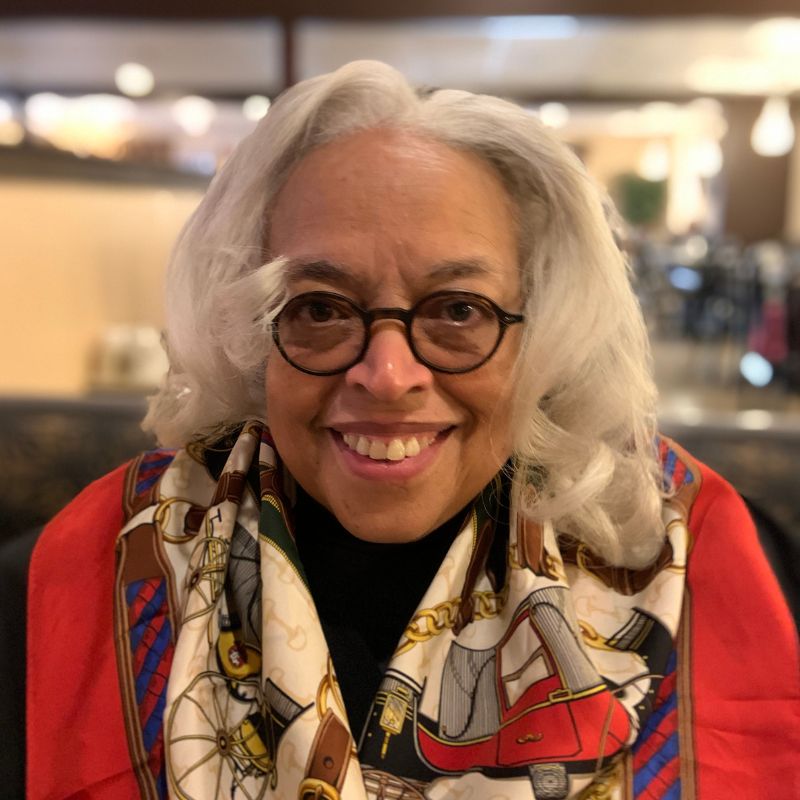
Linda Susan Jackson
Established
Literature: Poetry
Smyrna
"I bring the gimlet-eye of the mathematician/accountant to my poems, using simple speech and passion to convey life's complexities."
Work Sample
excerpt from “Let’s Begin Here,” in Lost & Found (2022)
Imagine beginning again, here, with my unadorned mind
That once cut a path through smoke on the road, the mind
Now trying to hold onto itself, the mind of a woman
Whose flaws are becoming forgivable fictions.
About the Artist
Written by Gail Obenreder
Linda Susan Jackson was not always a writer. In college, she first majored in mathematics, then accounting, and afterwards embarked on a successful corporate career. Jackson only began writing poetry in her late forties, when her two passions converged. “Most people don’t realize that mathematicians have the heart and soul of poets.” She believes that “both push against the limits of words, symbols, theories, and convention while exploring the expansiveness of imaginary worlds.”
The second child in a family of six children, Jackson lived most of her life in two New York City boroughs. She spent her formative years in Staten Island and moved to Brooklyn in her teens, where she remained, crafting two disparate careers and retiring twice. After twenty years in the business sector, she first retired as Deputy Commissioner for the NYC Department of Transportation.
Jackson then returned to graduate school to begin her second career, this one in the field of education. She earned a master’s degree in English literature, an MFA in Poetry and was a writer and college professor for the next twenty years.
In 2017 she retired from teaching and moved to Delaware, settling in Smyrna and continuing to write and publish poetry. She has published two full-length volumes, two chapbooks, and dozens of her poems have appeared in journals and anthologies. She has received fellowships from the Cave Canem Foundation, New York Foundation for the Arts, and The Frost Place, among others.
In her writing, Jackson prefers “not to button things up but to use my voice, as Auden does, to ‘undo the folded lie’,” celebrating and chronicling “ordinary, sometimes unremarkable lives that slip into the abyss of human history.” One of her early influences was her family, from whom she “learned the importance of story: everyone… has a story to tell.” Early on, she also had an appreciation of all kinds of music, noting that “sound and story figure prominently in my writing.”
Everything she has read informs her writing. She believes that “to be a good writer, it is essential to read,” and read widely. Jackson cites two disparate but equally important people from different fields who have influenced her work – author Toni Morrison and musician John Coltrane. “Both seemed to be on a search for answers to questions about human existence, about who we are as human beings.”
In spite of her success as a poet and a writer, Jackson says that she is still challenged by beginning something new. “Each time I approach the page, I feel as though I’m doing it for the first time, so I’ve learned to be patient, to wait and listen for the sound of those first words.”
She finds a great reward in “meeting and talking with other poets and expanding the reach of poetry” and is truly appreciative of receiving the Division’s Fellowship. “To be recognized by one’s peers is quite an honor.” And it’s likely that this award will send her in yet another artistic direction: “I’d like to try writing some non-fiction!”