

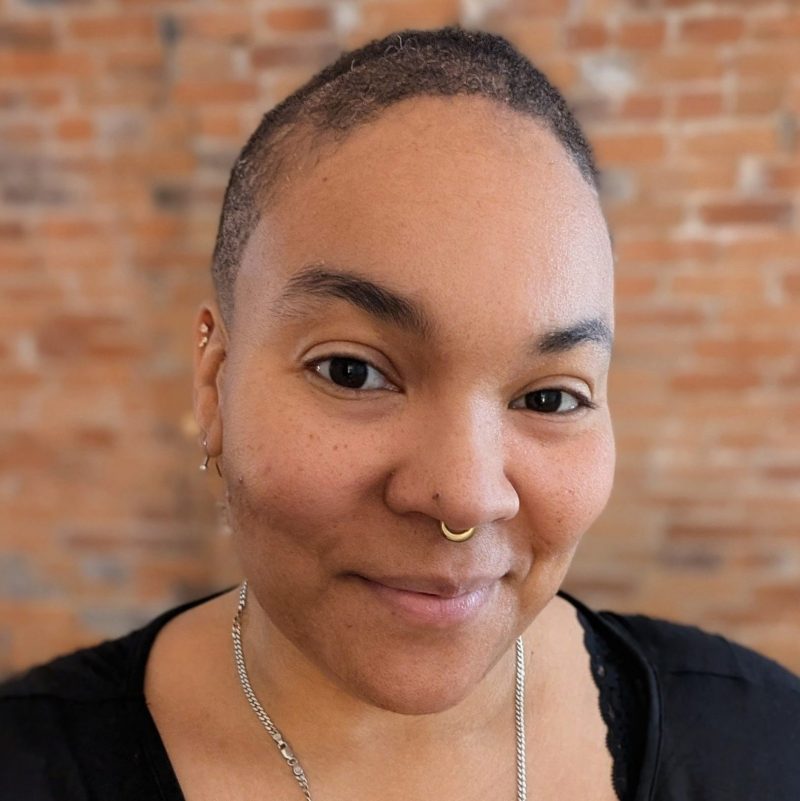
Yalonda JD Green
Established
Literature: Poetry
Wilmington
"My writing examines the ways that we collectively remember, frame, and vocalize our stories, particularly those that encircle the lives and afterlives of Black women."
Work Sample
“Music for Torching” (2023)
To Billie
Honey, how he still your man so low in his high pants
yellow stripes slick shoes tipping in drunk covered
in some heffa’s lipstick. Baby, you begging this strand of a man
to let you keep him talking how you rather he beat you than quit
you better he black your face than leave your bed. Cigarettes & gin
don’t hide the heft of your hurt or the slope of your want Shame
that blisters but never bursts hope that ambles when he calls you
babe & coos your name so brazen he don’t even pretend to change
I know that falling. Been knowing that hush now don’t explain I’ve mistaken
time for loyalty & longevity for love I’ve cursed a man while fixing his plate
Fixed my hair special candles & birthday cake waiting for a love
who never came I still miss tasting that mean man some days his sweetness
diversion as he broke me & gently hid the pieces I see the same fissures
in you, girl that matchbox in your pocket tinder sorrow waiting to be convinced
& pissed enough to bend down to help me gather him cradle him prop him
up & drag this fine & mellow bastard away from your wanting door
About the Artist
Written by Gail Obenreder
Poet Yalonda JD Green nurtures a relationship with writing that has “shifted and swirled” throughout her multi-faceted career as a librarian, writer, and educator, “always coming to the forefront in times of painful transition and a profound need to make sense of my life.” As she matured, Green was “never only doing one thing at once.” She sang, acted, taught, wrote, and read deeply as she pursued her academic studies.
Green grew up in Detroit, in the world of “scholarship, music, and Motown” before leaving home as a first-generation college student. In college, Green “experimented with philosophical essays [and] creative nonfiction while dealing with her mother’s terminal illness. In her senior year of college, following her mother’s death, she ultimately found that poetry “gave [her] space to talk about grief, trauma, legacies of motherlessness [and] provided the breathing room to explore [her]splintering selves as a young Black woman.
In 2010, she accepted a poetry fellowship from Cave Canem and released her independent album, Diurnal Movements. She went on to earn her doctorate (University of Louisville) in 2011 and a second master’s degree in library science (University of Kentucky) in 2019, working in Louisville, Kentucky as a children’s librarian, educator, and interdisciplinary artist for sixteen years. It was an academic position at the University of Delaware, as the Literature and Africana Studies Librarian, that brought her to The First State in late 2021. She made her home in Wilmington two years ago.
Over her career, Green returned periodically to writing poetry after completing her PhD in Humanities, but focused more closely on music, performance, and improvisation while working in the public library from 2013 to 2020. It was at a 2022 jazz concert in Philadelphia that she returned seriously to writing poems. As Lizz Wright sang, Green began humming and “scribbling in the dark.” She describes feeling something “dislodge.” “Despite years of neglect,” she says, “my work has waited for me.” And in 2023 Green began attending workshops and residencies (including the Division’s 2024 Writer’s Retreat) to “sharpen and deepen [her] practice.”
John Donne and the British metaphysical poets, and Toni Morrison, were some of Green’s earliest influences as a young writer, and so “when [she] eventually started writing poetry, things were a bit opaque.” But a creative writing professor introduced her to the writing of contemporary American poet Billy Collins. It was his work Picnic, Lightning that revealed how “poetry could be plainspoken, even funny,” and identified an artistic kinship when she connected with the works of Rita Dove, Lucille Clifton, Audre Lorde, Harryette Mullen, and M. NourbeSe Philip in grad school.
Green continues to draw inspiration from a variety of writers and musicians across disciplines, a testament to her wide range of artistic interests and pursuits. She often writes about “the world [she] observes and survives every day,” subscribing to Nina Simone’s belief that an artist’s job is to reflect the times. Not surprisingly, Green finds that “determining the best format for a conceptual idea [which she calls translation] can be difficult,” and she’s sometimes unsure whether “what’s coming through is a poem, a song, an essay, or some hybrid form of storytelling.” But with “trust and intuition wedded to [her] craft,” Green has learned to “value the disorientation until parts coalesce” and she can discern an artistic direction.
As a poet, Green appreciates and values that her work moves audiences: “connecting with folks’ spirits doing work that also sustains my own spirit gives [her] new life.” As she commits more deeply to her poetic craft, Green also continues to sing and pursue other expressive pathways. She hopes to use the Division’s Fellowship to expand her current poetic practice, explore new ways to work, and to collaborate with other Fellows in her cohort, thankful for the funds, affirmation, and encouragement that the award has afforded her.