

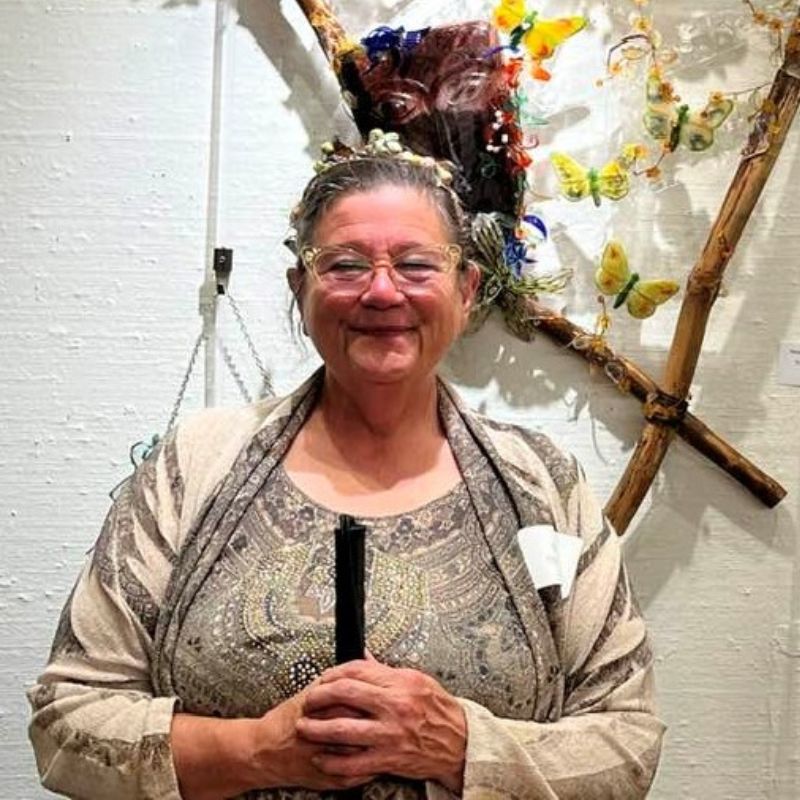
Trebs Thompson
Established
Visual Arts: Crafts
Newark
"I love telling stories, and making art is one more way I can do that. I also love breathing new life into discarded materials."
Work Samples
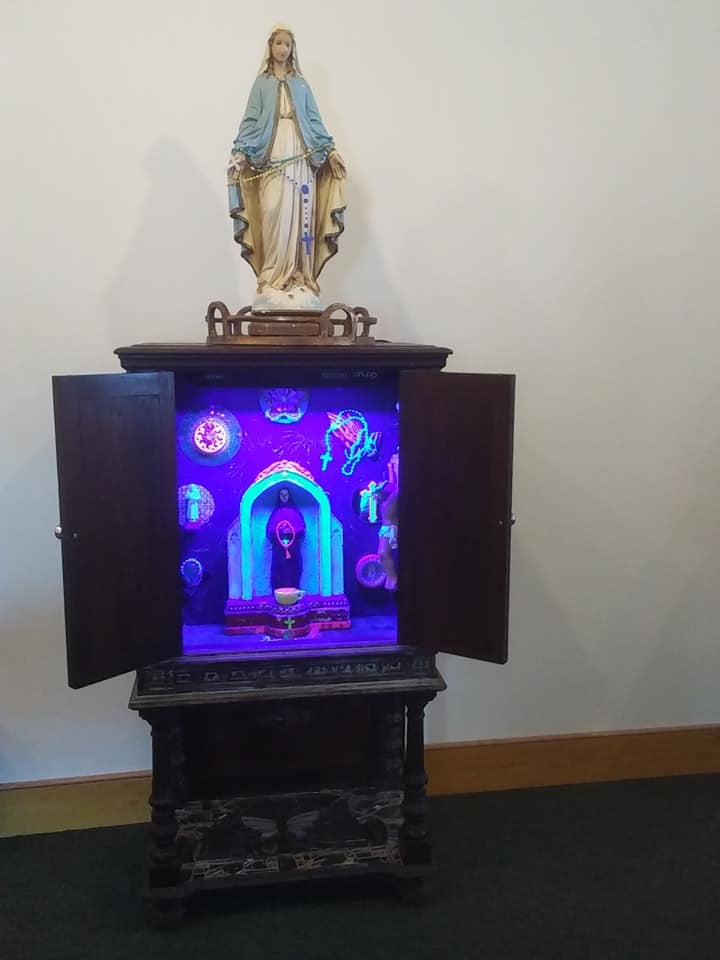
mosaic, traditional stained glass, mirror, found objects, neon
5 ft 8 in x 3 ft x 2ft
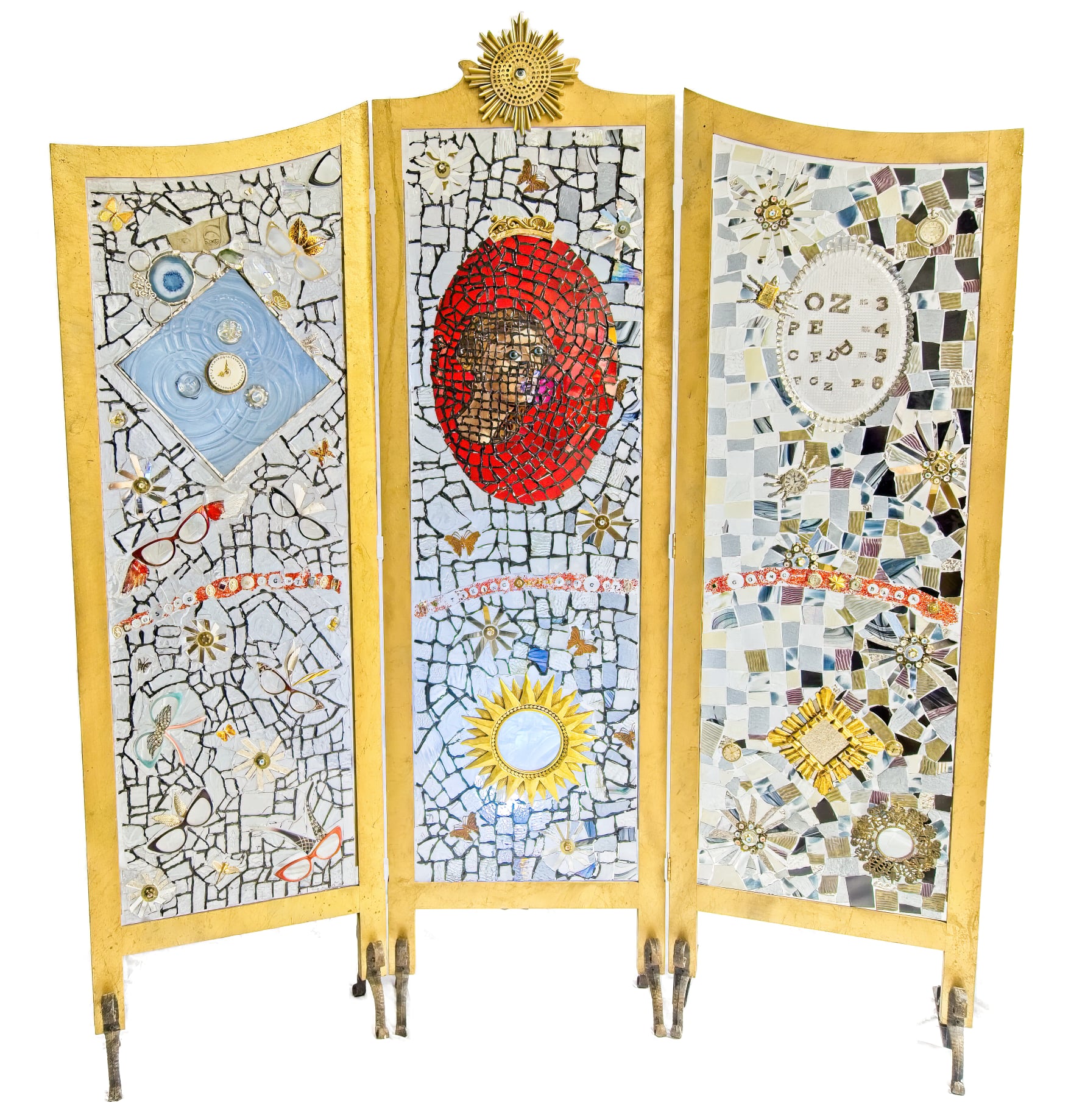
glass, porcelain, adhesive, mirror, found objects
48 x 22 x 3 inches
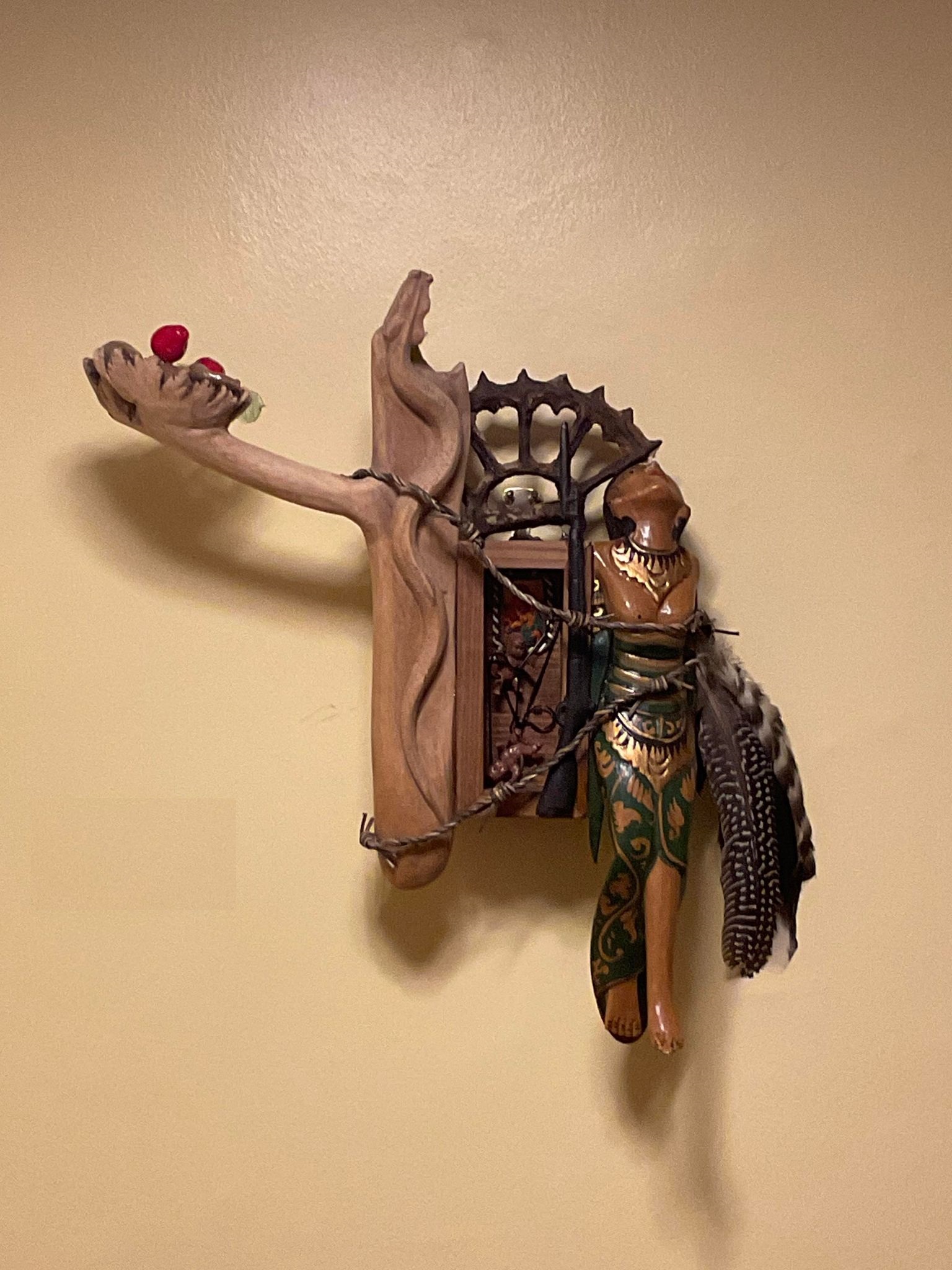
wood, feathers, leather, found objects
12 x 14 x 4 inches
About the Artist
Written by Gail Obenreder
Trebs Thompson began her career in glass painting and non-traditional glass sculpture with no formal art training. The self-taught artist saw glass as “the most exotic of materials, fascinated by the range of ways it could be used” as the medium to illustrate her life and her beliefs.
Thompson was an only child who has lived in Alabama, Texas, North Carolina, and Puerto Rico, where she attended high school. After finishing high school, she moved here in 1984 to attend the University of Delaware and Del Tech and fell in love with Newark, now her home. “Its proximity to big city life and a rural farming community was an excellent mix for me,” and since 2001, she’s been the proud owner-manager of busy Whimsical Farms.
The artist always revered old-world Italian and English master painters, along with “multi-disciplinarians such as [the great Catalan Antoni] Gaudi” and Louis Comfort Tiffany. But, most heavily influenced by modern artists like Peter McGrain, Judith Schaechter, and Loring Cornish, in her early 40s she began telling her stories in glass.
As she began her artistic journey, Thompson says that after handling random items, she felt that “they could show me how they wanted to be recreated,” so the artist began to incorporate found objects into her work. She started to exhibit in regional galleries and at local events, and as her passion for the craft grew, along with her skill, she began to mix neon lighting, casting, fusing, mosaics, and enamels into some of her creations.
But about a decade ago, Thompson found that she “began to have trouble doing soldering and fine painting.” Five years later, she was diagnosed with parafoveal macular telangiectasia, a rare blinding condition. Convinced that her budding career was over, Trebs almost gave up making art. But a late-night epiphany on a camping trip convinced her to try new techniques as her eyesight changed, a gambit which has been successful.
Since then, “I have focused on adapting my art to my decreasing vision.” These adaptations “have pushed me into working on a larger scale, experimenting with adhesives, and trying different techniques and materials.” Thompson often works with high magnification under harsh lights, learning new skills “to produce tactile works that would be both visually appealing and accessible to non-sighted audiences.”
In addition to her adaptive challenges, “as a farmer, new grandmother, and active community member” Thompson struggles to find dedicated time to work in her studio. But she still loves “breathing new life into discarded materials” and continues to be rewarded by “focusing more on the stories I want to tell” than on monetizing her art.
Thompson is a member of the Forgetful Squirrels, a local improv troupe, and she has recently finished a collection of humorous essays about her life as a farmer. But last summer she took her storytelling to a new level: “I made my debut on the Moth Radio Hour in Minneapolis.”
The Division Fellowship has “meant everything to me.” Because her disability severely curtailed her income, she will use the award to attend workshops, as well as purchase new materials and adaptive technology. It will also assist her to prepare for an exhibition at the Delaware Department for the Blind and Visually Impaired, undoubtedly inspiring students there with her indomitable will and her artistry.