

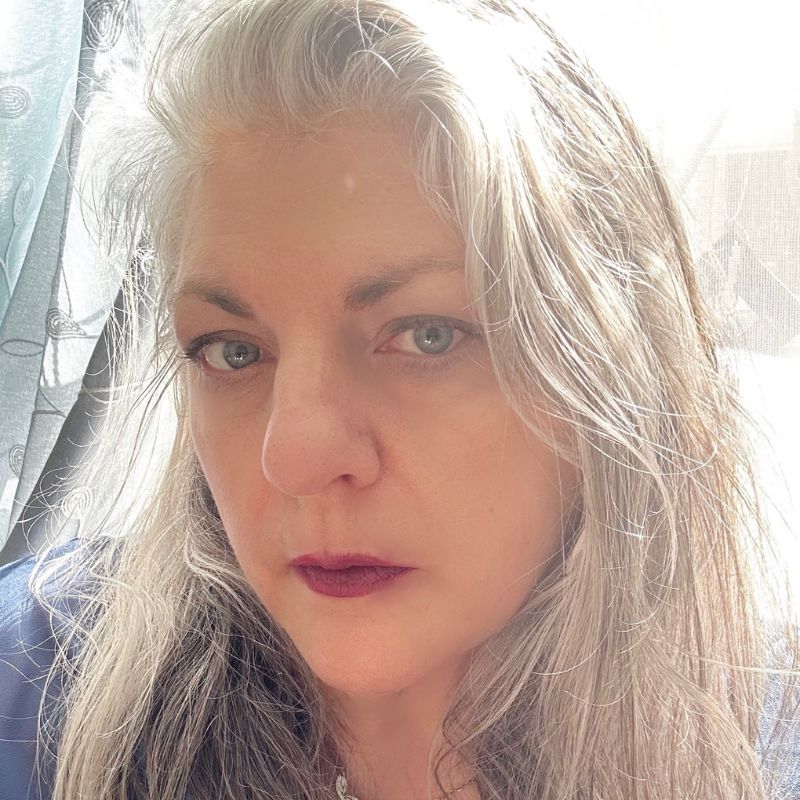
Joyce Enzor Maust
Emerging
Literature: Poetry
Dover
"What draws me to poetry is its brevity and the beauty of each word."
Work Sample
excerpt from Everything Before I Became Myself (2023)
Once, I opened a cocoon in winter-
melted caterpillar in streaks of gold and green and black –
like colors that edge my life, hinting at another form.
Do butterflies remember eating heartily in life? The pain in melting and reforming?
Do their wings ever ache to return Earthbound, a respite from the wind?
About the Artist
Written by Gail Obenreder
Poetry and poetic memorization were not just hobbies for Joyce Enzor Maust, they were woven into the very fabric of her childhood. Growing up in a conservative Mennonite community, she was immersed in a world where Christmas programs were not complete without reciting poetry and singing songs, a tradition she was part of from the tender age of three. Despite the community’s objections to women’s education, her parents were staunch advocates of learning and reading, fostering her educational goals.
Musical instruments were prohibited, so the “rhythm and rhyme of hymns and poetry provided the beat to life.” Central to her love of words was the influence of her great-aunt and great-uncle, community elders “whose poetry was frequently memorized and recited by the children.” This gave Maust a tangible example of the power of the written word. She was also captivated by the “relatable and whimsical” poems in Robert Louis Stevenson’s A Child’s Garden of Verses and devoured the poetry in her parents’ Ideals magazine.
Maust was the youngest in a family with five much older children whose father was a Conservative Mennonite pastor. The family lived in southwestern Pennsylvania on a dairy farm that had been in her family for generations. The beauty of the locale “offered breathtaking views and lots of space and time to roam freely in nature.” Growing up in this rural setting meant that she “learned many skills and different aspects of life” that were not always translatable to an urban setting, so her friends “refer to me as a vault of unusual, not always applicable, information.”
Because she has studied both English and physics, Maust sees the world “as a place of [both] absolutes and uncertainty.” Throughout her upbringing, “despite struggling to express the pain of the abuse that I endured, I was never at a loss for words.” At sixteen, she wrote her first personal poem “that captured the depths of my soul’s cry,” she found a release in that poetic voice. Although part of her “longs for the simplicity found in my Plain childhood,” Maust is dedicated to working through the tension from her “two juxtaposed worlds.”
In her work, she strives to “allude to intense and emotional subjects,” often referencing the abuse and pain she suffered in childhood, in a way that her readers can understand and access. For inspiration, she turns to poets like Paul Laurence Dunbar and Linda Blaskey, whose “use of accessible language… contains profound emotions.” As she works to “give voice to stories of pain often overlooked or silenced,” Maust finds a great reward in “the universal bond that sheds light on the complexities of human experience.”
Her move to Delaware “was only to have lasted a year.” However, twenty-nine years later, the Dover resident is still here, grateful for the Division’s Fellowship that will allow her to prioritize her writing and focus on expanding her artistic practice. She plans to delve into new subjects and connect with other poets. Maust is most excited that this award affords her “the ability to give words to memories and experiences often kept locked away within the Plain community,” connecting them to “the humanity in all of us.”