

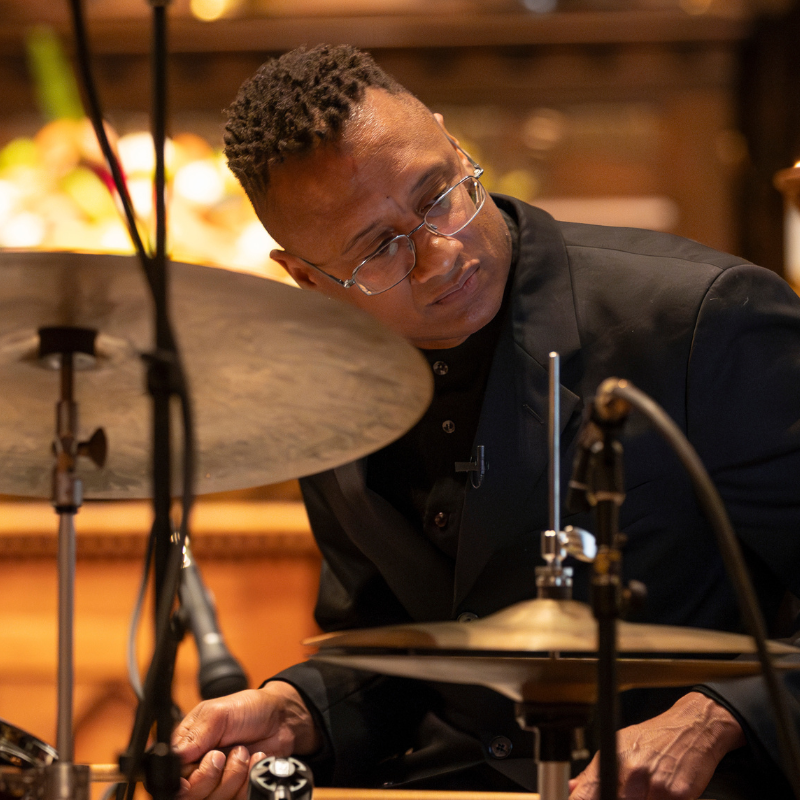
Jonathan Whitney
Established
Music: Composition
Wilmington
"My life is dedicated to using the arts to address the world we live in through performance, social practice, community building, presenting, and education."
Work Samples
Length of full work: 3 minutes 53 seconds
Role in creation: Composer
Length of full work: 17 minutes 10 seconds
Role in creation: Composer
About the Artist
Written by Gail Obenreder
For composer Jonathan Whitney, “music has always been in my life.” His father, an organ technician by trade, had been a professional drummer, and Whitney grew up listening to reel-to-reel recordings of the band. There was also an organ in the house that “I could play around on.” On Thursday nights, when he was supposed to be asleep, Whitney would sit at the top of the steps and listen to his father’s expert vocal group rehearse hymns and spirituals.
Whitney grew up in Newark, earning his bachelor’s in music education at the University of Delaware and receiving Master of Music in jazz studies (drums) at Philadelphia’s University of the Arts. Except for that formative post-college stint, he has been a Delawarean all his life.
He was introduced to his first classical recording at a private undergraduate lesson – it was the Philadelphia Orchestra playing Rimsky-Korsakov’s Scheherazade. “From that moment on I listened to everything I could get my hands on from Bartok to Bach to Berlioz.” Whitney’s undergraduate supervisor for work-study was Vernon James, a composer and woodwind player who often toured with Gil-Scott Heron, and it was James who “taught me what it meant to be an artist.”
“Inspired by the power of music to amplify the energy of an object, a moment in time, a person, or a place,” Whitney is buoyed by the Delaware artists around him. He is also inspired by musicians who expand the genre’s vocabulary and reach, including Miguel Zenon, Tyshawn Sorey, and Caroline Shaw, as well as other disciplines including the “deep community-based storytelling practice” of Urban Bushwomen, a dance group.
For Whitney, music “works as a bridge to help listeners connect to moments in history.” He has reached a point in his career where he can spend considerable research time when writing a composition, and one of his latest projects musically tells the story of Cooch’s Bridge, Delaware’s newest historic site. The multi-movement project – which includes a composition for pipe organ and three percussionists – has been unfolding since 2022, but it is deeply referential of his formative musical experiences.
His work “challenges me to look deeply into an object, a story … and interpret it through music,” a process that can be all-encompassing and exhausting. And he also is drawn to write for “ensembles I haven’t had experience with… learning their qualities [and] colors.” But as a composer, he finds it deeply gratifying when people connect with those objects and stories in new ways through the fresh perspective that his music offers.
If he’s not composing or playing or working as bandleader with the Whitney Project, an ensemble he founded over a decade ago,” Whitney is “a car guy. When I need to quiet my mind, I work on my car, or my brother’s car, or my neighbor’s car.” He and his brother once put an engine in a car and drove it to Utah and back!
Whitney received a previous Artist Fellowship from the Division in 2020, and the current award will help him “complete and record a volume of string quartets.” He sees this as important for growth as he works toward orchestral composing; these quartets will allow him to “climb into the string section” and learn its sonic possibilities. As a 2026 Fellow, Whitney acknowledges that not every state has a support team like “we have in Delaware, and I am grateful for all that they do in the arts.”