

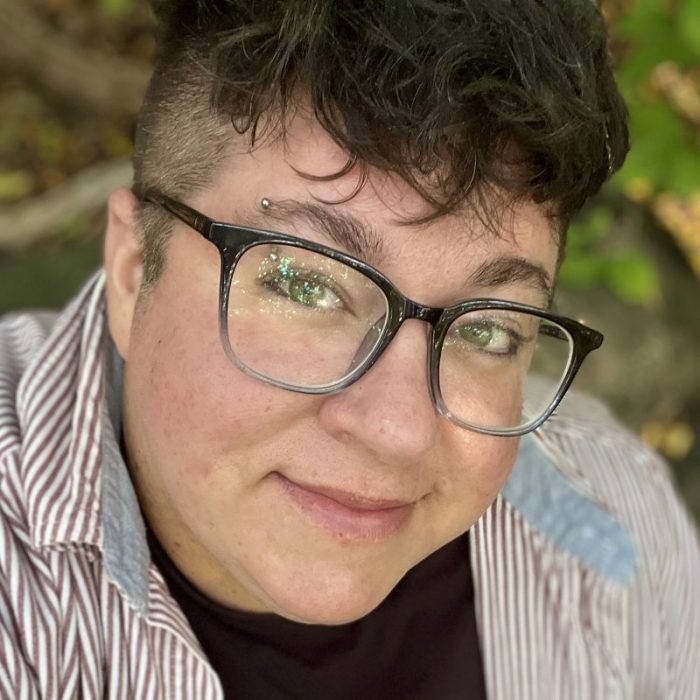
Hadrian Cerulean
Emerging
Literature: Poetry
Wilmington
"Since I write while immersed in nature, I consider myself a ‘plein air poet.'"
Work Sample
“Dawn” (2025)
As first light begins to break,
I am in bed with my lover, and
I tenderly watch her awaken
Shy tendrils of her fiery curls have
sprung loose, framing her radiant face
Her cherubic cheeks are rosy,
as if in anticipation for the day
Her eyelids flutter, then she slowly
opens her bright eyes
When she realizes that I too am awake,
her petal pink lips part into a smileAt this early hour,
before the birds
sing their reveilles,
all the world is quiet
and still —
only she and I exist
She is mine and I am hers
We lie side-by-side, gazing
into each others’ eyes…
She whispers her secrets
And I whisper back
About the Artist
Written by Gail Obenreder
Though he’s worked in multiple visual arts mediums, Hadrian Cerulean began writing poetry in fifth grade, “when I first learned what a poem was,” and he simply never stopped. Language and words have always fascinated him. As a child, Hadrian Cerulean wanted to become a librarian to be around books, and later he aspired to be a lexicographer because “I loved the dictionary so much.” In college he majored in linguistics and studied languages, including Arabic, Hungarian, Russian, and German.
Hadrian Cerulean grew up on the central Atlantic coast of Florida and spent his childhood at the beach, fishing and canoeing with his two brothers. That early love of the natural world is still with him, evident in his work, and he’s found that “through the lens of nature” he gains an ever-deepening understanding of “love, death, identity, sex, relationships, trauma, and spirituality.”
As a child, he copied down poems from library books and “taped them to the wall by my bedside so I could memorize them” as he fell asleep. Early influences were “nature poets” like Coleridge, Wordsworth, and Frost, but Hadrian Cerulean finds himself moved by contemporary painters and musicians as well. And he’s inspired by contemporary poets like Andrea Gibson and nonfiction nature writers like Robin Wall Kimmerer (Braiding Sweetgrass) and Douglas Tallamy (Bringing Nature Home), as well as “the art and poetry of my friends.”
Because writing poetry doesn’t require equipment, designated studio space, or a lot of materials, Hadrian Cerulean is able to work most anywhere, including outdoors. “All you need is a writing implement and paper, and sometimes not even that!” He just carries a pen and notebook, or failing that, uses his phone to capture those evanescent ideas.
Given his penchant for arts of all varieties, Hadrian Cerulean is sometimes challenged by choosing the medium in which he’d like to work. He’s lately discovered that “reading my poems aloud in front of an audience” is a new experience, one that has changed how he writes, now striving for more clarity and accessibility. It’s most rewarding when, as a poet, he can express something “meaningful and true in a beautiful way that creates connection and understanding with others.”
After living in Richmond, Virginia and Gainesville, Florida, Hadrian Cerulean moved to the First State and has been here for thirteen years. “I’m grateful to live here. I basically consider myself a Delawarean now.” The Wilmington resident frequently hikes in local parks, collecting rocks, where he tumbles them “until they’re shiny and beautiful.” He continues his love of languages and is currently learning French. Though he claims not to be fluent yet, he’s actually written a bilingual poem. Other passions extend to the rights of marginalized groups and equity in education. And passionate about the importance of native plants, he’s currently enrolled in Mt. Cuba Center’s Ecological Gardening Certificate program.
In 2022 Hadrian Cerulean participated in a poetry workshop, also at Mt. Cuba, something that was “incredibly helpful, inspiring, and encouraging.” He’s grateful that the Division’s Fellowship will enable him to participate in more workshops, further connecting him to the state’s writing community, and allow him to devote more time to writing as he “continues to learn, grow, and improve as a poet.”